Disease
When white-tailed deer are at high population densities, the risk of disease transmission increases.
Vector to Deer
The more deer there are in fragmented environments, the more likely they are to make contact with vectors of disease. Deer act as hosts to these vectors of disease, supporting their populations and allowing them to spread over much larger areas than the vector could travel on their own.
Terminology
- Vector of disease: an organism that carries and transmits diseases to other organisms
- Example: ticks and mosquitoes
- Reservoir host: maintains pathogen population, supports transmission of pathogen between vectors
- Reproductive host: provides an environment for vectors to breed and lay eggs, supports vector population growth
- Dispersal host: aids in the movement/dispersal of vectors over distances that the vector cannot travel alone
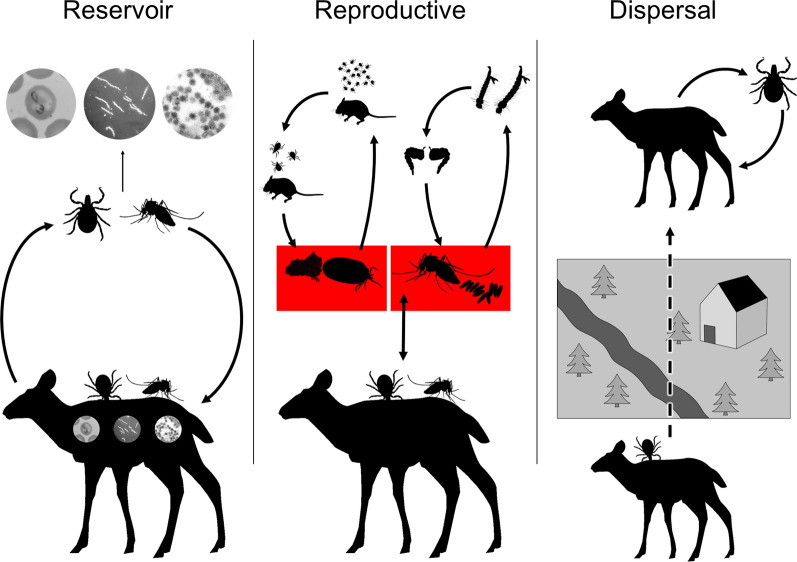
Deer to Human
Through their role as hosts of disease vectors, deer increase the likelihood of human infection. The risk of tick-borne diseases sharply increases when deer populations are above 8 deer per square kilometer, and by acting as a reservoir to mosquito-borne pathogens, deer can amplify viral incidence.
Tick-Borne Diseases
- Human monocytic ehrlichiosis
- Lyme disease
- Human babesiosis
- Heartland virus
- Bourbon virus
- Rickettsiosis
Mosquito-Borne Diseases
- Jamestown Canyon virus
- Cache Valley virus
- Eastern equine encephalitis virus
site information
This website was made for Biology 240: Ecology and Evolution, by S.K. and N.A.R.